
DeSoto Parish VINE Inmate Coverage
Louisiana's service is the Louisiana Automated Victim Notification System, or LAVNS. VINELink provides its online person search and notification controls. The DeSoto Parish Sheriff's Office links LAVNS from its official site, and DPSO's local beta data carries the Louisiana VINE site identifier and the DeSoto sheriff agency identifier. Louisiana DPS&C also directs public custody searches to VINELink.
That creates two records a user might encounter for the same name. The local sheriff record concerns DeSoto Parish custody. The DPS&C record concerns state prison custody. A person released from the parish jail to the state system may appear out of local custody while remaining confined under DPS&C. Read the agency before reading the status, and never merge records merely because the names look alike.
LAVNS follows participating events through arrest, bail, court, sentencing, incarceration, and release. Available detail varies by agency. Louisiana also distinguishes ordinary LAVNS registration from Louisiana Victim Outreach registration, which is required for some state-prison notices, including certain projected and actual release notices. One local subscription should not be described as covering every state notification.
Search DeSoto Parish VINE Records
Start with enough identity detail to distinguish the person from others with a similar name. Full name, date of birth or age, offender or inmate ID, booking date, and known agency are useful. Preserve the date and time of the search because participating data may change.
- Open Louisiana VINELink and select the Person search for Louisiana.
- Enter the surname and given name. Add an offender ID or another offered filter when known.
- Review candidates without assuming the first name match is correct. Compare identifiers and agency details.
- For local custody, choose the DeSoto sheriff agency record. For a state prisoner, choose the Louisiana DPS&C record.
- Open the matched record and copy the custody label, event date, reporting agency, location, and update time exactly as displayed.
If no result appears, check spelling and known variants. Then contact the facility thought to hold the person. VINE says records can include people in custody or recently released, but it is not a full historical archive. A no-hit cannot prove release, absence of detention, or the end of a case.
The official Louisiana person-search screen shows the current starting point:
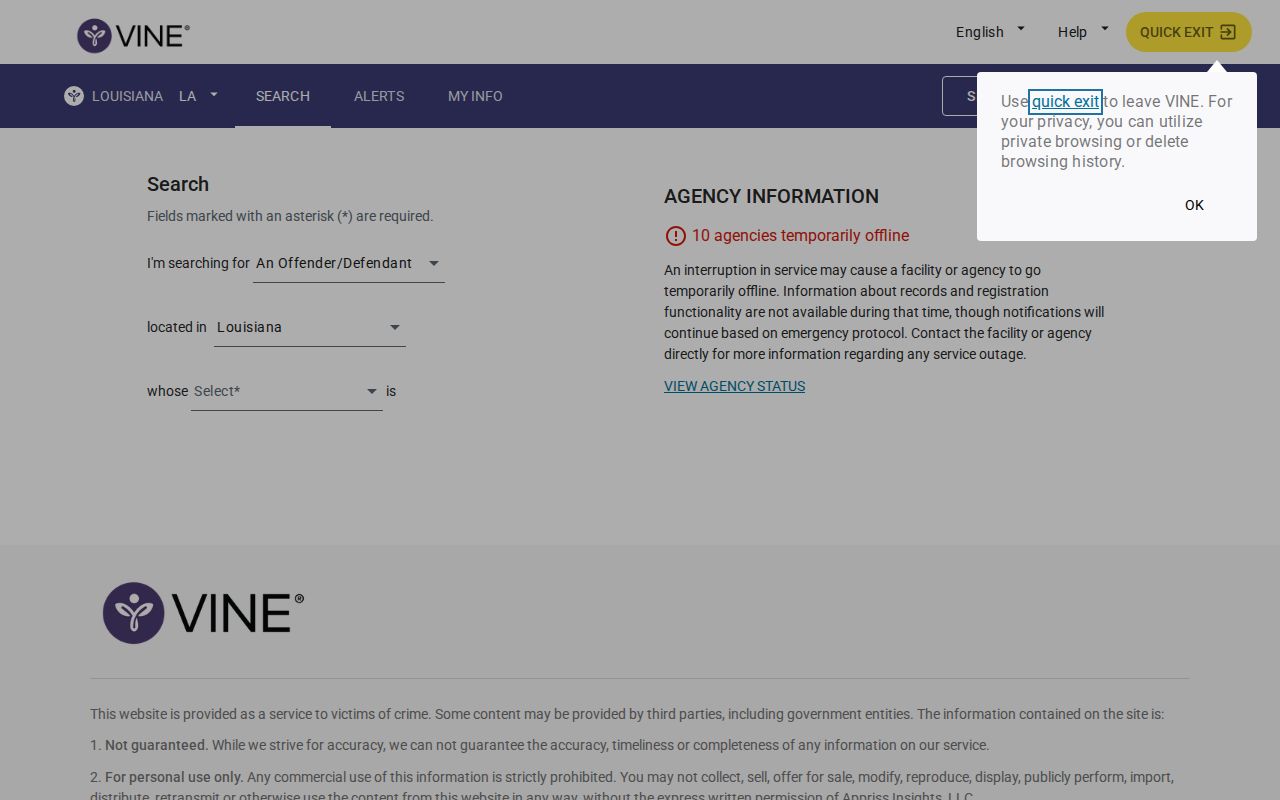
The screen is statewide, so the agency match is essential. Use the DeSoto sheriff entry for the parish jail and the DPS&C entry for state custody.
DeSoto Parish VINE Release Fields
VINELink fields vary with the contributing agency and the selected record. The interface may provide a custody label, location, identification details, event information, or release-related dates. Do not rename a field. A projected or scheduled date is not an actual release date, and an out-of-custody result applies only to the reporting agency.
| Field | How to read it |
|---|---|
| Person name and identifier | Use with birth or booking details to confirm the correct person. |
| Reporting agency | Shows whether the record belongs to DPSO, Louisiana DPS&C, or another participant. |
| Custody status | The contributing agency's current label; read it narrowly. |
| Facility or location | The location supplied by that agency, which may change after transfer. |
| Event date or update time | When an event was reported or data refreshed, not always the physical movement time. |
| Release-related date | May be projected, scheduled, or actual depending on the exact displayed label. |
A released or out-of-custody label supports only that the named agency no longer reports the matched person in that custody status. It does not prove charges ended, supervision ended, or another authority did not take custody. If DPSO reports release while a DPS&C record remains active, treat the person as still within the state system unless officials clarify otherwise.
Note: Save the agency and event time with the status because a label copied alone can hide a transfer between custody systems.
Register DeSoto Parish VINE Alerts
Register only after matching the right person and agency. Current options can include telephone, text, email, or an in-app or web notice. The interface may change, so follow the controls shown on the selected record and confirm that the subscription summary names the intended person and agency.
- Open the matched person record and choose “Get notified” or “Register for notifications.”
- Select an offered delivery method. The interface recommends using at least two methods when possible.
- Enter the phone number, email address, or account destination and accept the current service terms.
- For telephone registration, choose and repeat a four-digit PIN. Keep it private.
- Complete the email or text confirmation link or code when prompted, then review the person and agency shown.
During a VINE call, listen to the message and enter the PIN followed by the pound sign. The PIN acknowledges receipt and can stop repeat calls. Without acknowledgment, the service may leave a message and retry under the jurisdiction's rules. Text often sends one message per reported status change, but the event types offered can vary.
Account users may be able to keep a universal PIN and manage subscriptions together. The PIN is also needed to change notification settings. Call the LAVNS line at 866-528-6748 when web registration or confirmation fails. Notifications are an aid, not guaranteed advance warning, so keep another safety and verification plan.
Confirm DeSoto Parish VINE Changes
A notification reports what a participating agency sent. It is not a court-certified release order or a jail release log. Data can lag physical movement, and the event may concern transfer rather than return to the community. Keep the message, source agency, and time. Then call the office that owns the record.
For a DeSoto Parish Detention Center event, call 318-872-2295 and request a written release or transfer log when proof is needed. For state custody, use the DPS&C automated offender-information line at 225-383-4580 and ask the department about a public record if the web result is unclear. For federal prison custody, use the BOP Inmate Locator. Immigration detention has a separate ICE locator.
A court record answers another part of the event. The 42nd Judicial District Court docket may show a bond order, dismissal, sentence, or time-served entry. That legal action can explain why custody changed, but DPSO's operational record establishes when the person actually left its custody. The DeSoto Parish released inmate search sets out the full source chain for cases that cross systems.
DeSoto Parish Victim Alerts Beta
DPSO maintains a local “Victim Alerts (Beta)” page. Its data identifies the Louisiana VINE service and DeSoto sheriff agency. During the July 2026 audit, the local beta feed contained in-custody records only. That is a valuable local clue: choose the DeSoto agency record inside VINELink when following parish-jail custody, but do not use the beta list as a release archive.
The DPSO Victim Alerts Beta page shows the local integration:
The displayed local feed supports current-agency matching. It does not add a rolling released-person list. Registration should occur on the selected person record in VINELink, where the user can verify both identity and agency before choosing alert channels.
Note: If the local beta page and VINELink differ, treat VINELink as an alert source and ask DPSO to resolve custody.
DeSoto Parish Alerts Versus Proof
Fast notice and durable proof serve different needs. VINE can warn that a participating agency reported a move. DPSO can provide the parish release or transfer event. DPS&C can confirm the state custody or discharge record. The court can explain the order behind a local change. Using each source for its own job prevents the common error of treating an alert as unconditional freedom.
- Custody alert
- A notice that a participating agency reported a status event.
- Release log
- The facility record of when and how the person left that facility's custody.
- Transfer
- Movement from one agency or facility to another, not release to the community.
- Discharge
- The end of the relevant custodial or supervision term as recorded by the responsible authority.
When two records conflict, do not choose the newest screen by default. Compare agency, event type, and identifiers. A VINE alert tied to a local record and an active state record may both be accurate because the person left DPSO and entered DPS&C custody. Precise wording keeps that distinction intact.
Another useful check is the event sequence. A court order may come first, followed by a jail move, a VINE update, and then a state intake record. Those timestamps describe separate steps. If the DeSoto record reports out of custody but the state record has not appeared, call DPSO before assuming the person returned home. The receiving system may need time to publish its entry.
For a completed local release, request the DPSO release screen or log with the booking number and event fields. For a state discharge, ask DPS&C for the public record that states the release or discharge date and supervision status. A VINE screen can point to the right custodian, but the agency record is the better source when an exact legal or physical date matters.
Notification settings also need periodic review. A phone number or email address can change, a message can be filtered, and an account can contain more than one subscription. Reopen the account controls, confirm the correct person and agency, and keep the four-digit PIN available only to the registrant. Do not cancel another delivery method until the remaining route has been tested.
Keep a simple record of each alert. Note the delivery channel, message time, named person, reporting agency, and event wording. Then write down the result of the agency call. This small log makes it easier to distinguish a late alert from a new custody event and avoids treating the arrival time of a text or email as the official release time.