
DeSoto Released-Inmate Photo Records
A booking photograph is created as part of an arrest and identification process. It is not a court disposition, and it does not show whether a charge ended in dismissal, conviction, or another result. DPSO publishes many current booking photos on its live roster. That practice shows that the sheriff makes those current images public, but it does not prove that every historical photograph must be released without review.
Release changes the custody record, not the original meaning of the photograph. When a name drops from the current roster, the image may disappear from that public view even though the agency retains a booking record. DPSO publishes no archive window and no dedicated released-person gallery. Ask for the existing image by name, booking date, and inmate ID rather than using the roster’s disappearance as evidence of release.
Louisiana Public Records Law begins at La. R.S. 44:1 et seq. An adult may request public records subject to applicable exceptions. Active investigations, juvenile matters, sealed or expunged material, medical or identifying data, security information, and victim information may limit disclosure. A requester can ask for segregable public fields when part of a file is withheld.
Find DeSoto Released-Inmate Mugshots
No single channel is complete. Match the image to its source before calling it a DeSoto Parish booking photo. The local roster and app concern current DPSO bookings. A state record concerns the agency that supplied it. Registry and news images serve still other purposes.
| Channel | Photo availability | How to access |
|---|---|---|
| DPSO live roster | Current entries ordinarily include a photo; placeholders can appear | Search while the person remains listed and match booking details |
| DPSO mobile app | Mirrors current-inmate information and photos | Use the official app, but do not expect a release archive |
| DPSO records request | A historical image may be produced after review | Name the photo and booking precisely on the official form |
| DPS&C or VINELink | A contributing agency may supply an image | Match the agency; do not relabel a state image as the local booking photo |
| LSP or OffenderWatch registry | Photos appear for people legally required to register | Use only for a qualifying registry record |
| Official news and social posts | Selective arrest images may remain online | Verify the later court and custody status separately |
| Commercial aggregators | Images may be copied and stale | Treat only as a lead; rely on agency and court records |
A photo match does not establish a release. Confirm the custody event through DPSO, LAVNS, the release log, and the court record. If an image appears only on a nonofficial page, locate the primary record before repeating any status attached to it.
DeSoto Sheriff App Photo Limits
The DPSO current roster is the primary official online booking-photo channel. It offers searchable booking cards, charge and bond information, and photographs. It has no release date, time, reason, destination, or out-of-custody field. A person shown there is in the current display. A person who is absent may have been released, transferred, filtered out, or recorded under another spelling.
The official DPSO roster screen shows the current-booking layout where a DeSoto Parish photograph may appear:
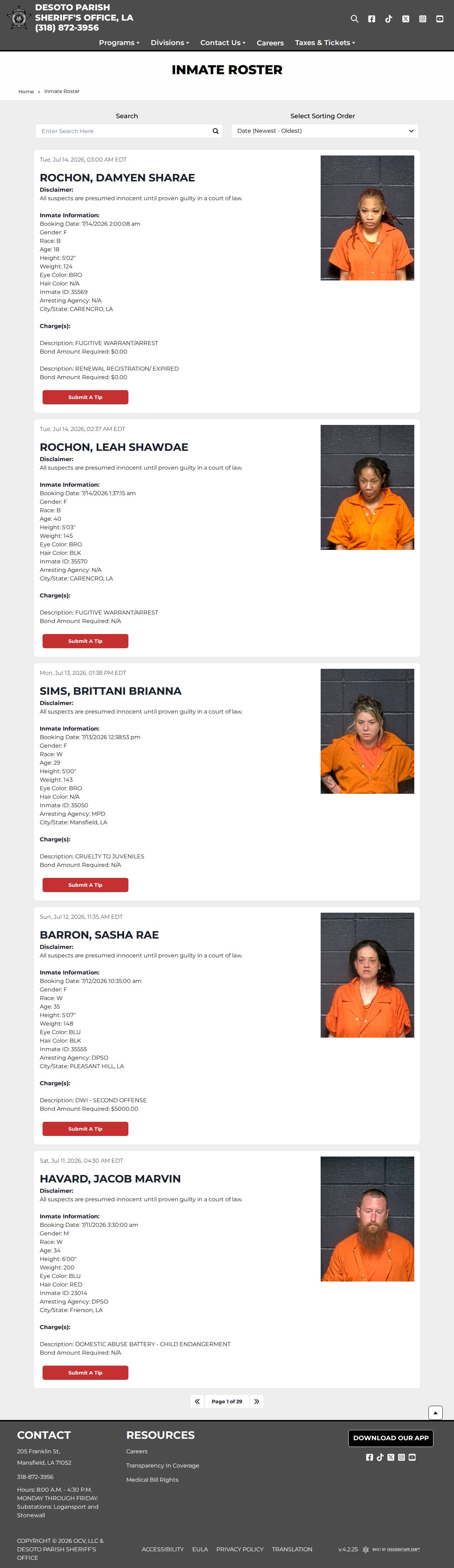
The roster capture demonstrates a current photo channel, not a gallery of people who have been released.
DPSO also promotes an official sheriff mobile app. The app describes current inmates, charges, visitation, and commissary. It does not advertise a recent-release archive. The web and app channels are two ways to view current data, not a way to reconstruct everyone released in a selected period.
The DeSoto Parish 24-hour release check explains the same-day fallback when a current photo card vanishes. Call the jail, check the matching VINE agency record, and request the release sheet. Save the booking ID while it is visible because it can make the later photo request more precise.
Why DeSoto Booking Photos Returned
Booking photographs have a local publication boundary. A January 2025 report on the DPSO website redesign said booking photos had “returned.” The relaunch synchronized public information across the website, app, and Facebook, but the product remained a current-inmate list. That history helps explain why an older booking image may not be visible through today’s interface.
The redesign does not create a statutory promise that every image will remain online. A placeholder may appear in a current record, and a departed entry may no longer be in the public display. Absence can reflect product history, retention, access limits, or ordinary current-only design. It should not be taken as proof of expungement, innocence, guilt, or release.
The local relaunch report documents the return of photos. The official records route, not an old copied page, is the next step when the desired image predates or has left the live roster.
Request a DeSoto Booking Photo
DPSO accepts written public-record requests for existing records. Request the historical photograph together with the booking and release sheet so identity and event dates can be checked. A narrow description reduces the chance that the agency must clarify a broad request.
- Download and complete the DPSO Public Records Request Form. Fill in the applicable fields, then sign and date it.
- Identify the person by full name, date of birth or inmate ID, and approximate booking date. Ask for the booking photograph, booking sheet, and actual release or transfer fields maintained for that event.
- Email the signed request to publicrecords@dpso.org or mail it to DPSO Custodian of Records, 205 Franklin Street, Mansfield, LA 71052.
- Do not send payment at first. DPSO says it will issue an estimated cost under its posted fee schedule.
- Pay the estimate by check or money order within ten working days of the notice. DPSO says an unpaid estimate expires and a new request is then required.
Ask for electronic delivery where available and an itemized estimate before authorizing costly reproduction. If the photo is withheld or redacted, request the legal basis and any segregable public portion. Louisiana’s response rules should not be misread as a guarantee that every complex request is produced within one fixed period.
DeSoto Photo News and Registries
DPSO press releases and official social posts may preserve an arrest image after the current roster changes. Local news outlets can do the same. Their coverage is selective and often focused on the allegation at the time of arrest. Pair any image with the 42nd Judicial District Court disposition and maintain the presumption of innocence. A news date is not a release date.
The Louisiana State Police registry and the DPSO OffenderWatch path may show photographs for people legally required to register. A registry image is not a complete archive of people released from the DeSoto Parish jail. Absence from the registry says nothing about an ordinary release.
Commercial aggregation pages sometimes mirror booking photographs. They can misstate timestamps, retain removed images, or attach an unsupported recent-release label. No commercial mugshot publisher or paid removal service is endorsed or linked here. Use such material only as a clue, then verify the identity, image source, court disposition, and custody event through official records.
Match DeSoto Photos to Agencies
A person can have more than one official photograph. The DeSoto Parish image may come from the local booking at DPSO. A Louisiana DPS&C record may carry an image provided for a state-prison record. VINELink displays information from participating agencies, so a local sheriff record and a state corrections record can both appear under the same name. Match the agency identifier, offender or inmate number, date of birth, and booking or admission date before treating the images as the same event.
A transfer makes the distinction especially important. When DPSO says a person was released to DOC, the parish release is a transfer into state custody, not a return to the community. The local booking photograph remains tied to the DeSoto event. A later state image belongs to the corrections record. Neither image alone shows when the person ultimately left state custody or whether supervision followed.
Federal and immigration systems are different again. The BOP Inmate Locator is the historical path for a person committed to federal custody, but it is not a local booking-photo archive. ICE’s detainee locator addresses immigration custody and should not be used to identify a DPSO photograph. A person held briefly for the U.S. Marshals may be housed in a contract facility without a complete public BOP locator trail.
For each image, write down the source office, record number, date shown, and the purpose of that record. Then use the matching release or court channel to answer custody status. This avoids the common error of finding a valid photo in one system and attaching a release claim drawn from another.
DeSoto Expungement and Photo Access
The DeSoto Parish Clerk’s Criminal Division provides an expungement form and separate misdemeanor-marijuana instructions. Louisiana expungement is a court process governed chiefly by Code of Criminal Procedure articles 971 through 995. Eligibility depends on the disposition, offense, waiting period, and prior history. The clerk excludes juvenile and 42nd-JDC-sealed records from its public criminal access.
Expungement restricts public access to covered arrest and court material. It should not be described as proof that detention never occurred or as a promise that every old lawful publication vanishes. When an official page still displays information believed to be restricted, contact the agency that maintains it with the order and enough details to identify the exact record.
No DeSoto-specific pay-to-remove policy was found. The Title 44 provisions reviewed did not reveal a Louisiana-specific anti-pay-to-remove clause, and current R.S. 44:3 has no special booking-photo provision. This is a bounded finding, not proof that no rule exists elsewhere. A current codified citation is needed before claiming a removal right.
The most reliable correction path is source-specific. Ask DPSO about its booking photo, DPS&C about a state image, the registry office about a registry photo, and the clerk about the court order. Do not assume that one agency can remove an image controlled by another.